Don't buy an imported car with a hidden past.
We check odometer, accidents, flood & write-off history, theft and recalls across 1200+ databases. NZ$15.90: full report in 60 seconds.
900M+ Vehicles in database
NZ$15.90 Full report
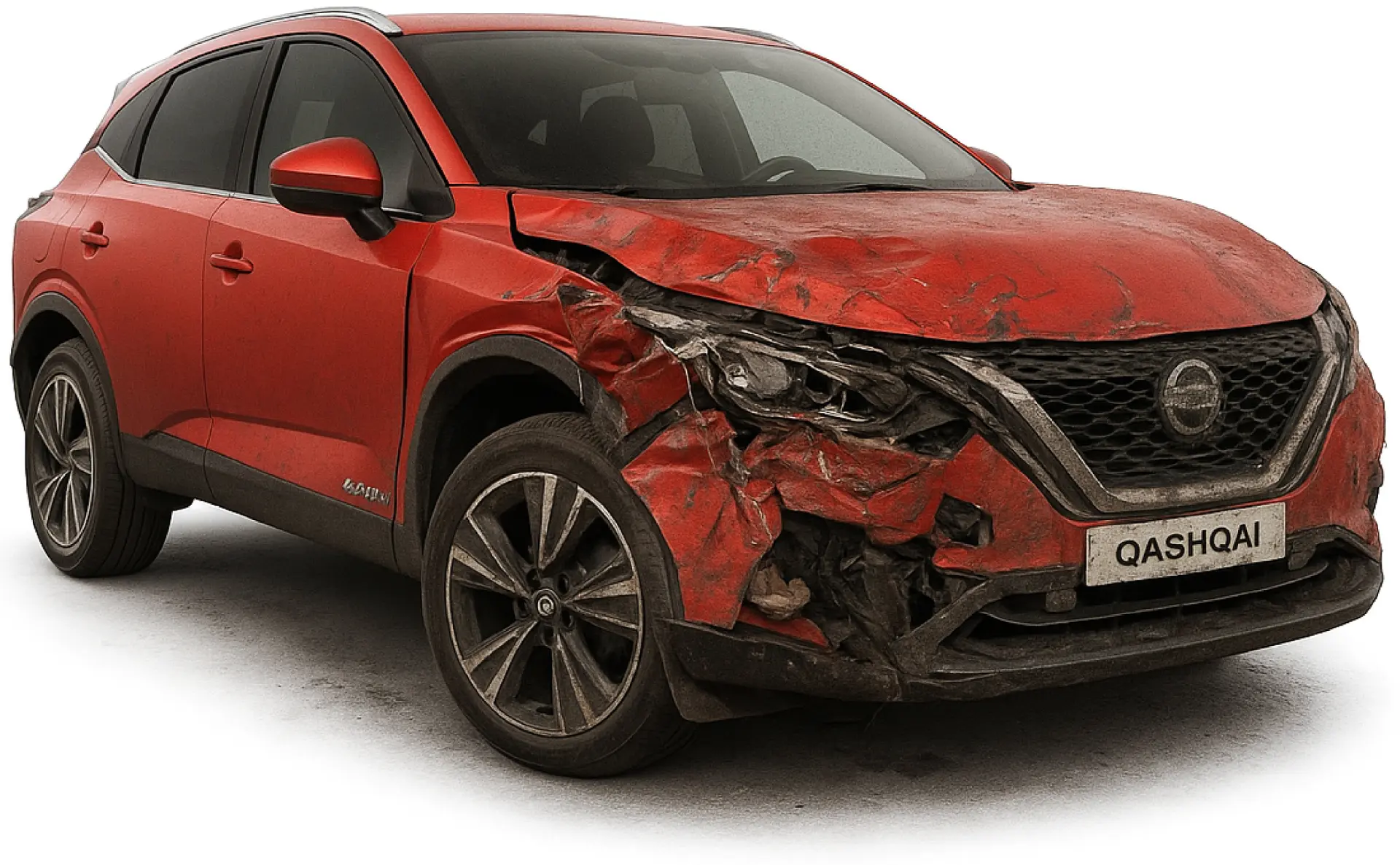
Carlytics is a free VIN decoder and vehicle history platform that cross-references 900+ million vehicle records across 47+ countries. For New Zealand buyers of used and Japanese-import cars, each check reconciles the origin-market history (odometer, flood and accident branding, theft) against the car being sold. Full reports from NZ$15.90, one-time payment, no subscription.
What we check for when preparing a report
Carlytics is the largest online database of used vehicle records. It contains more than a billion data points from all over the world.
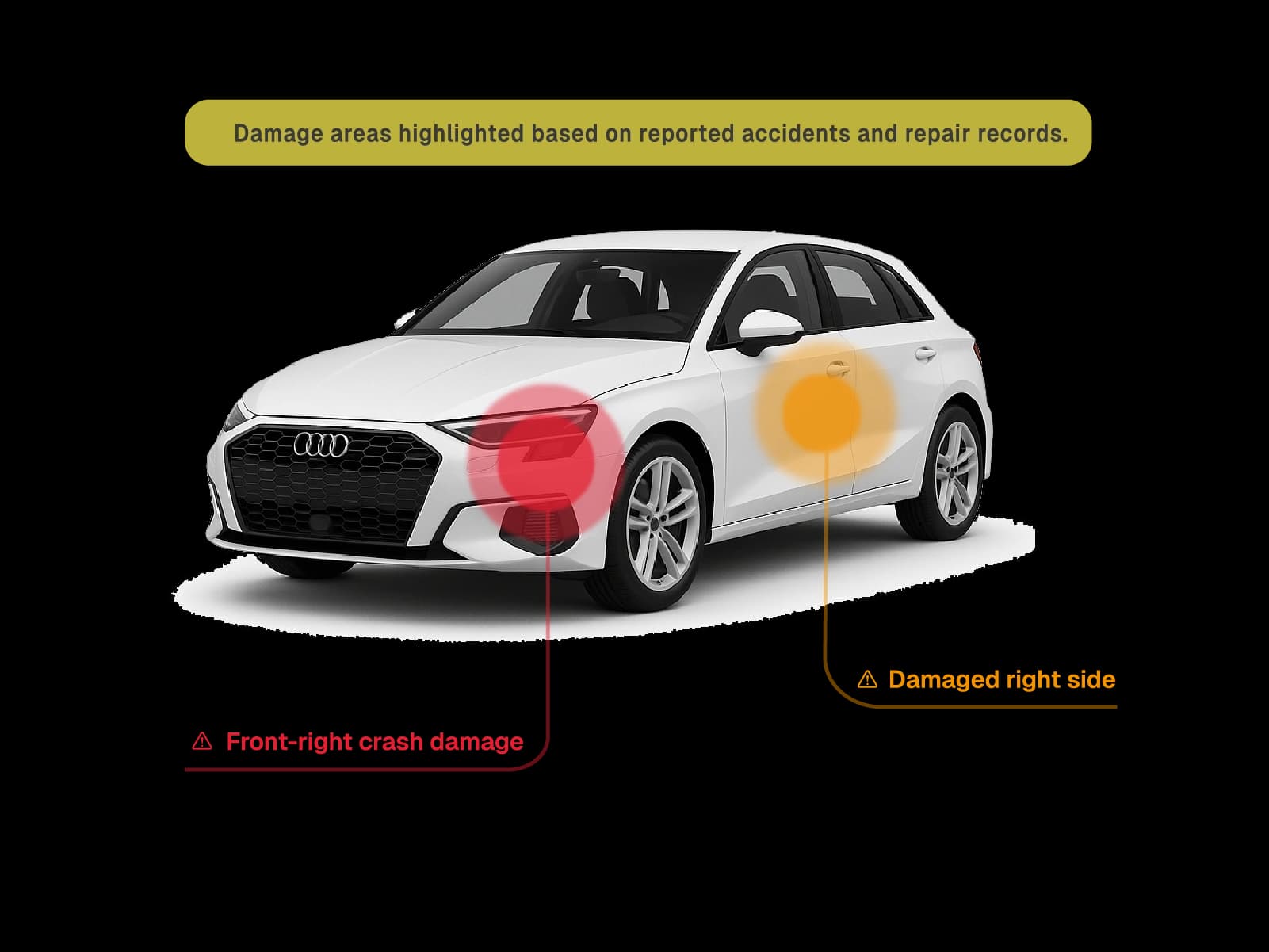
Damage
The report includes accident and damage records where available for the VIN. No record found is not proof the car was never damaged. Damage can lower the car's value and cause safety problems. Our report helps you avoid cars with hidden damage that sellers might not tell you about.
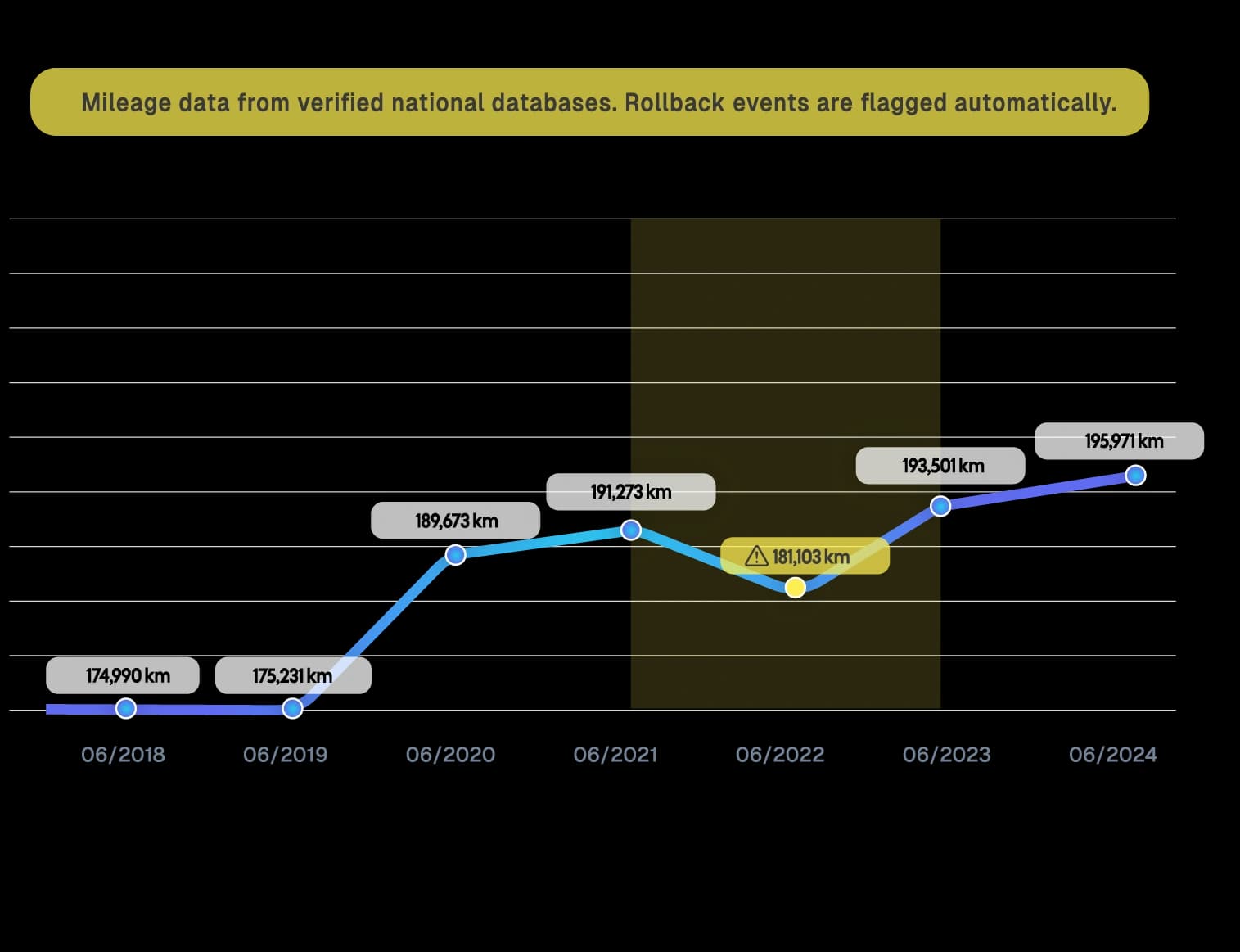
Mileage rollbacks
We look for signs that the mileage might have been changed. Some sellers lower the mileage to make the car look newer. We check mileage records from different databases to make sure the numbers are honest.
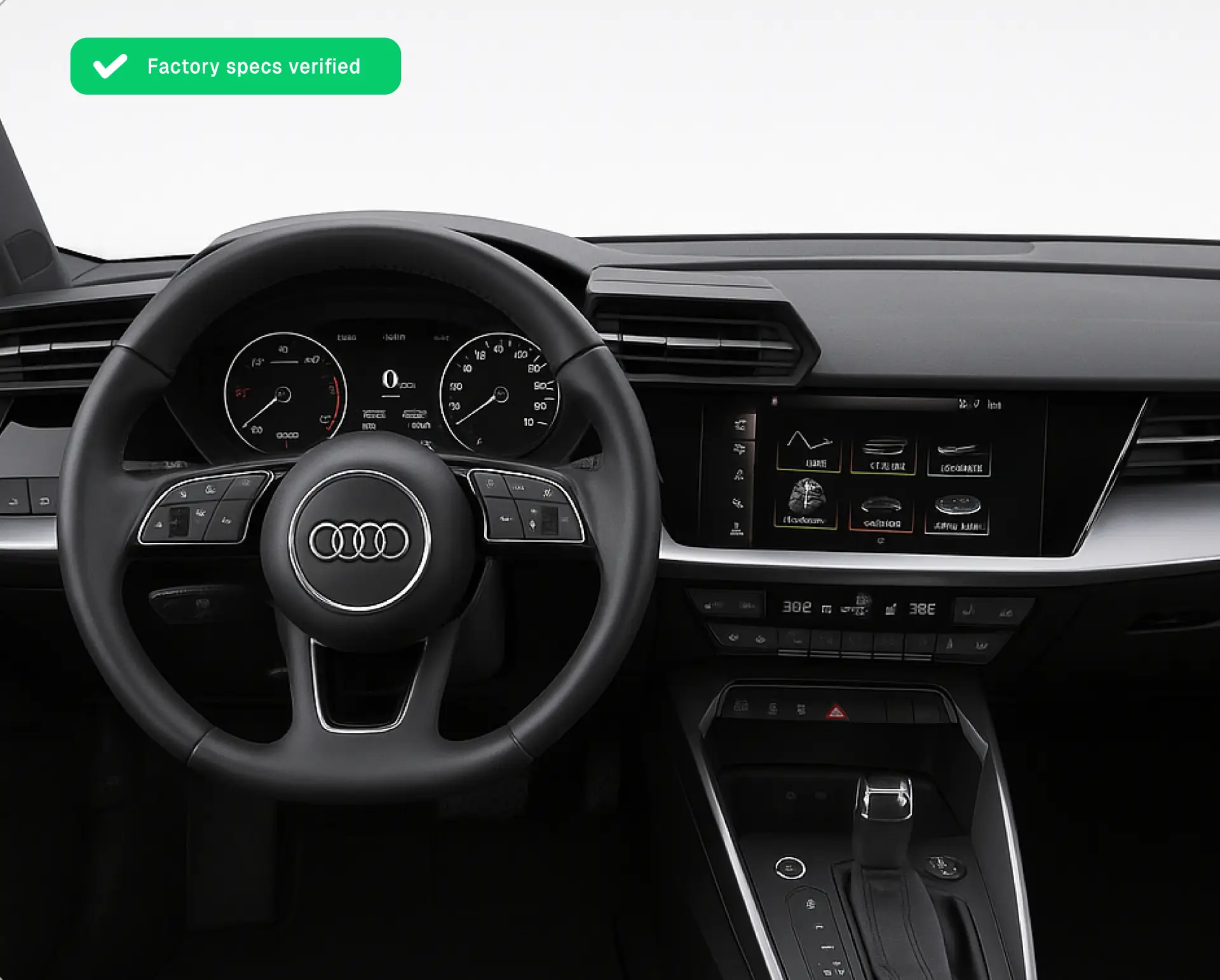
Specs & equipment
We list the car's original features and equipment. This helps you see if anything is missing or changed. You'll know exactly what the car should have when it left the factory.
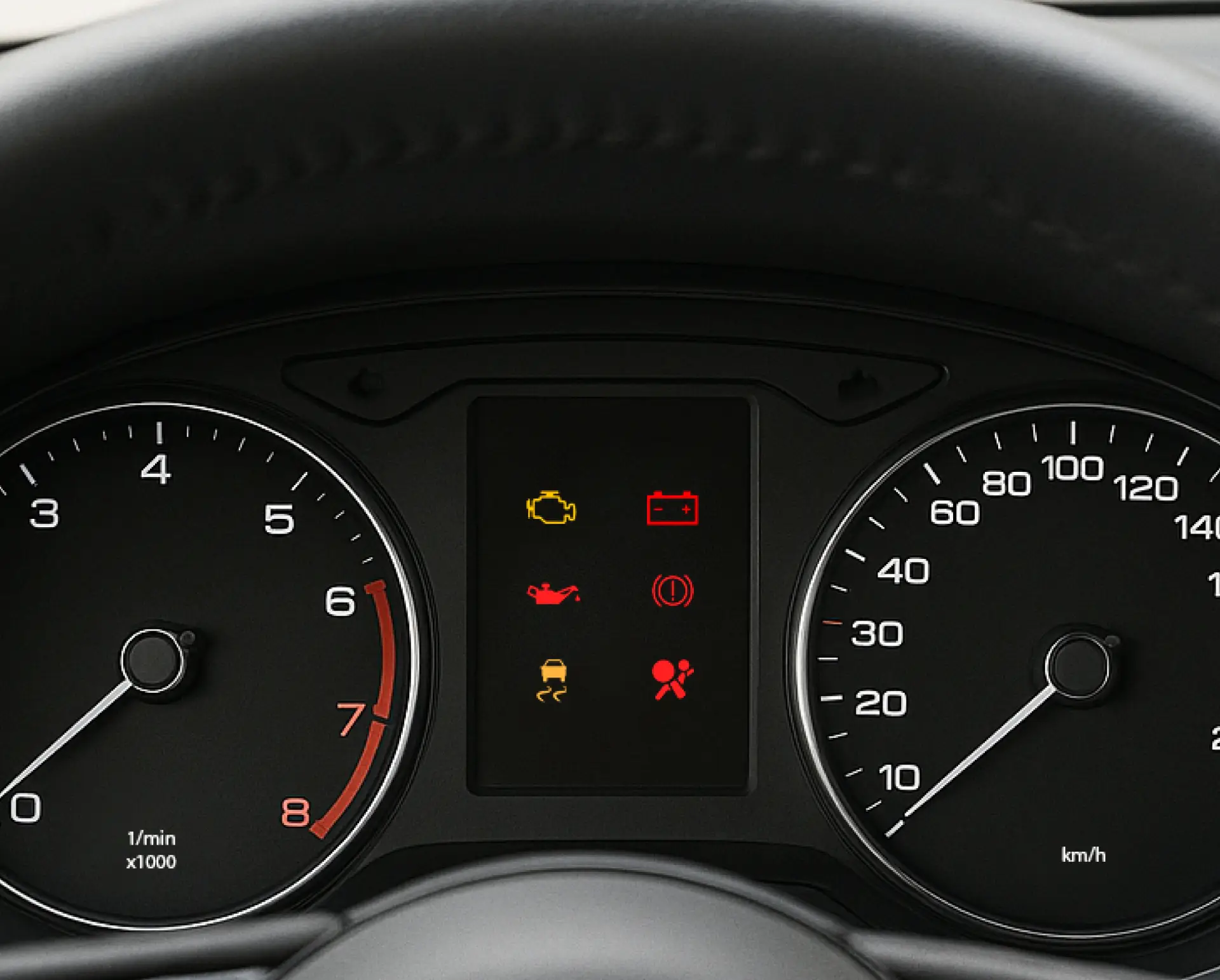
Safety
Manufacturers typically issue safety recalls to fix harmful defects. Make sure your car doesn't have any before taking it on the road and also learn its general safety rating.
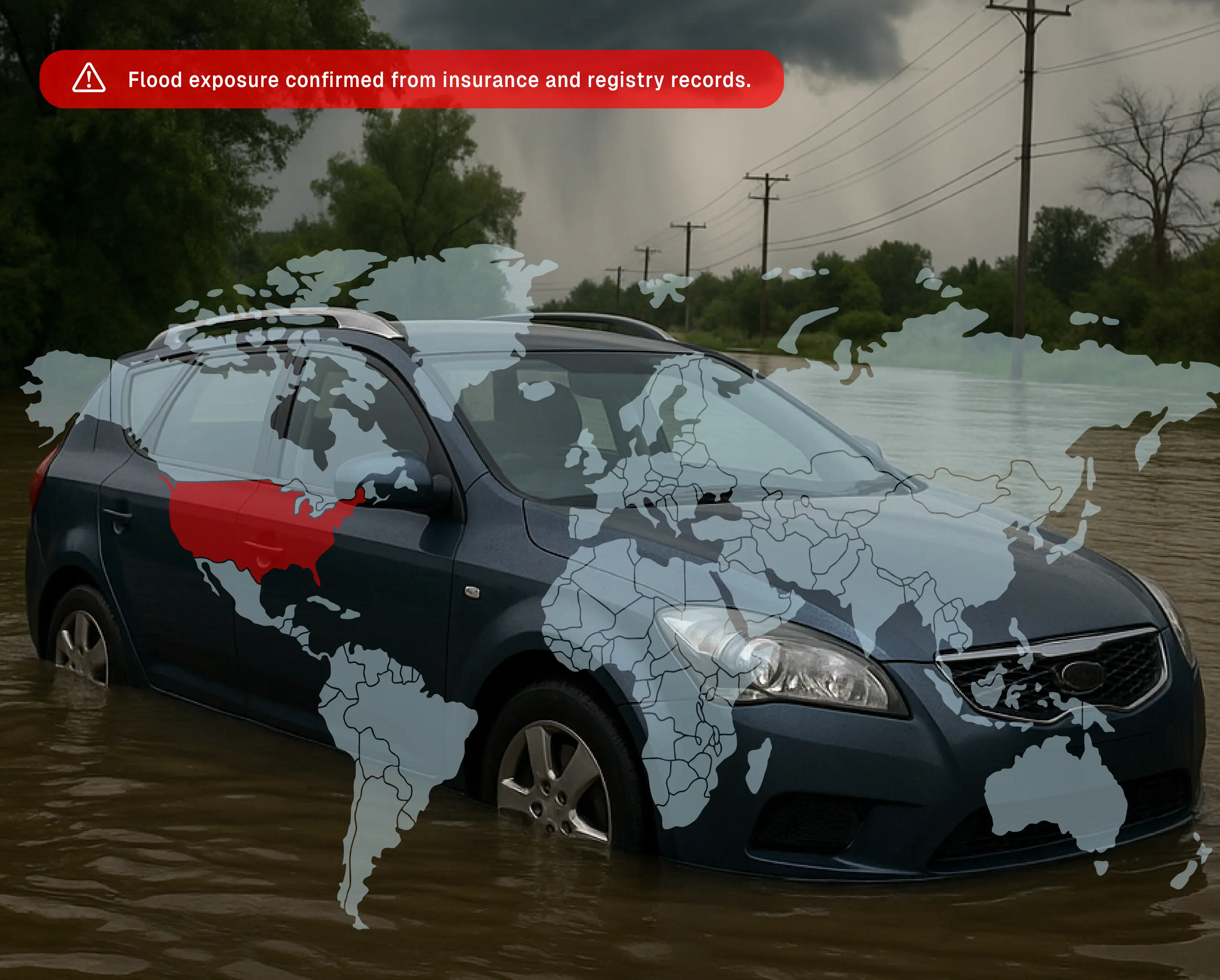
Natural disaster
Check if the vehicle has been damaged in floods, hurricanes, or other natural disasters.
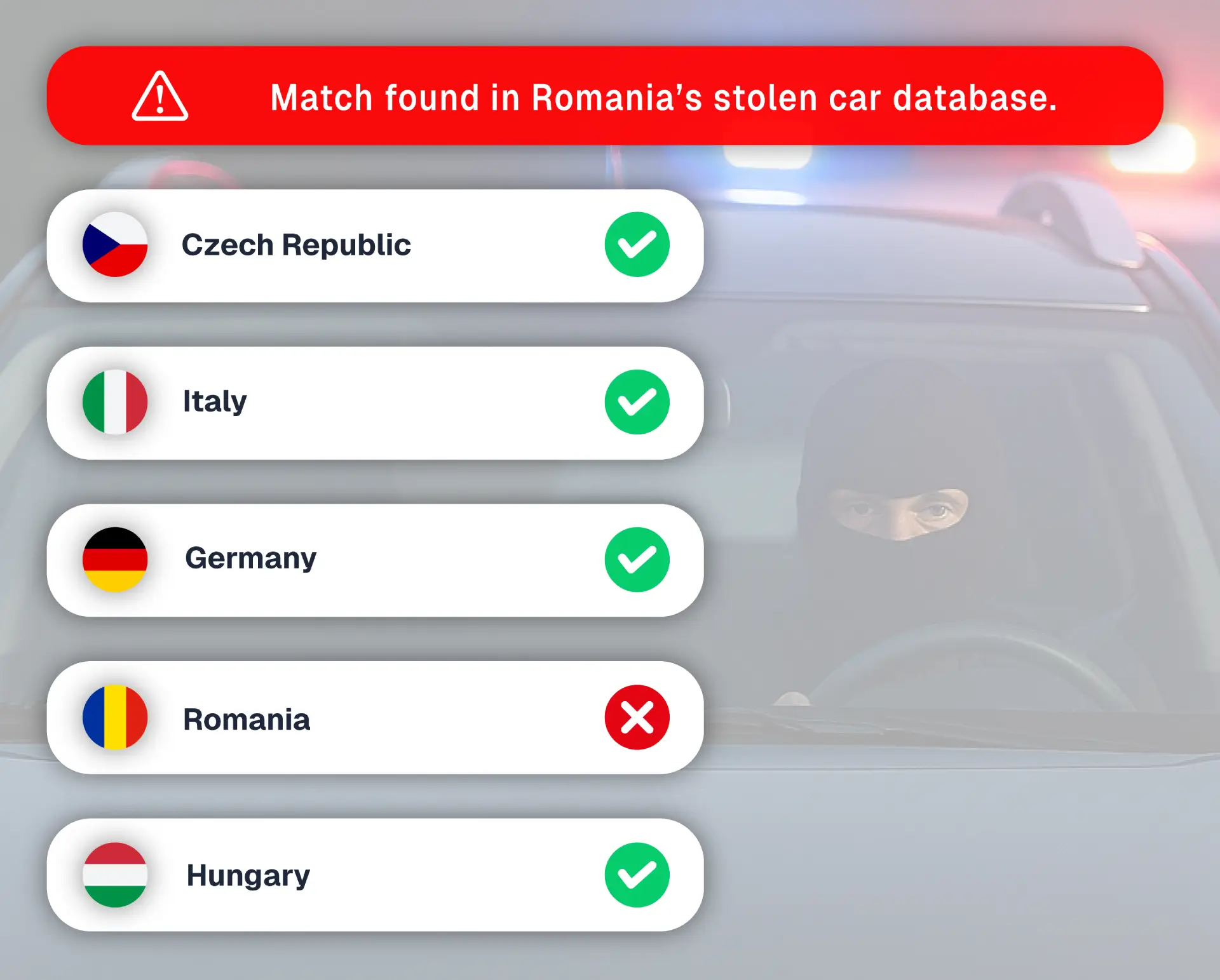
Stolen car database
We check police and insurance records to see if the car has been reported stolen. Buying a stolen car can lead to big legal and financial problems. Our report gives you peace of mind.
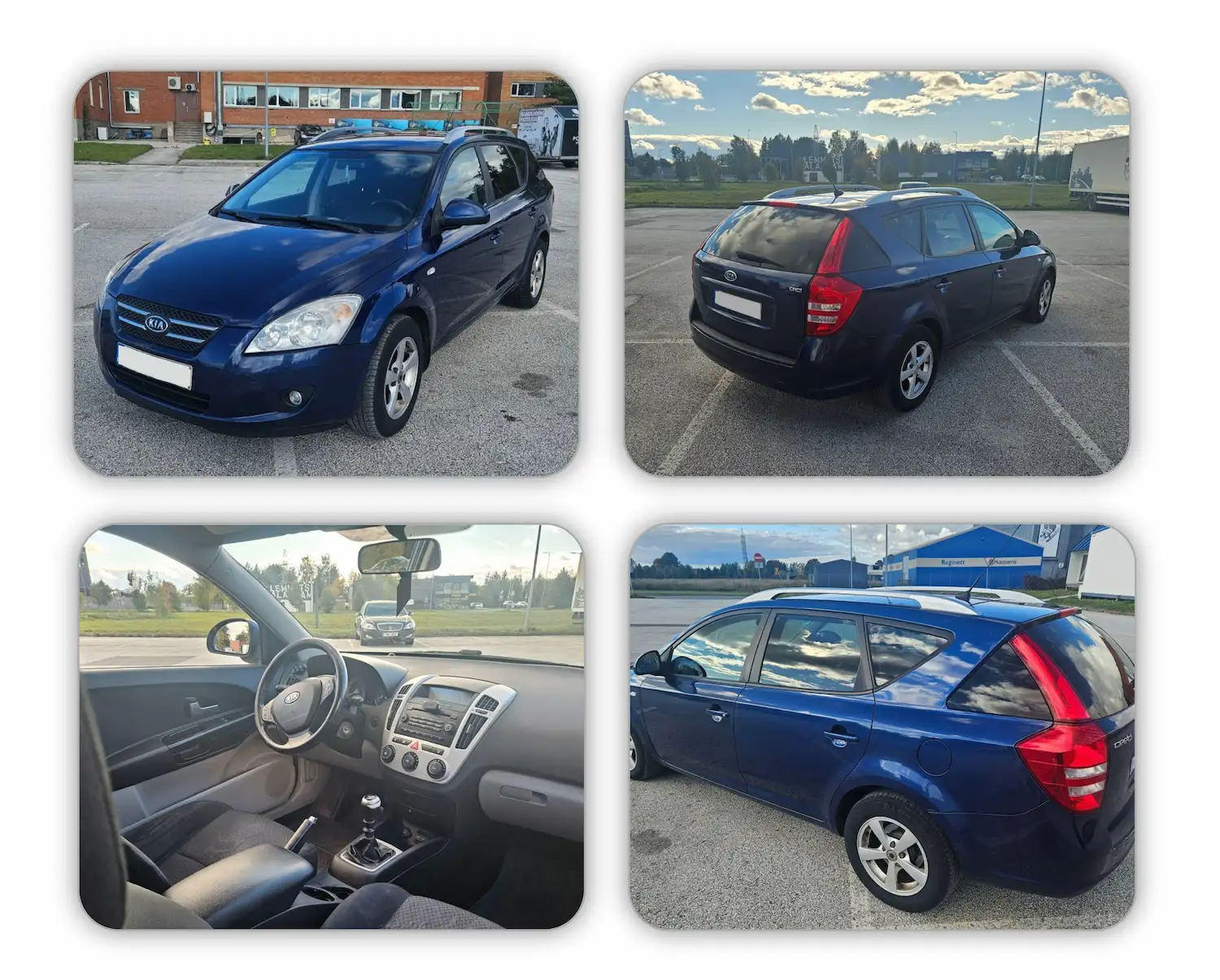
Photos
If available, we include old photos or auction pictures of the car. These photos can show past damage, repairs, or changes that you might not notice in person.
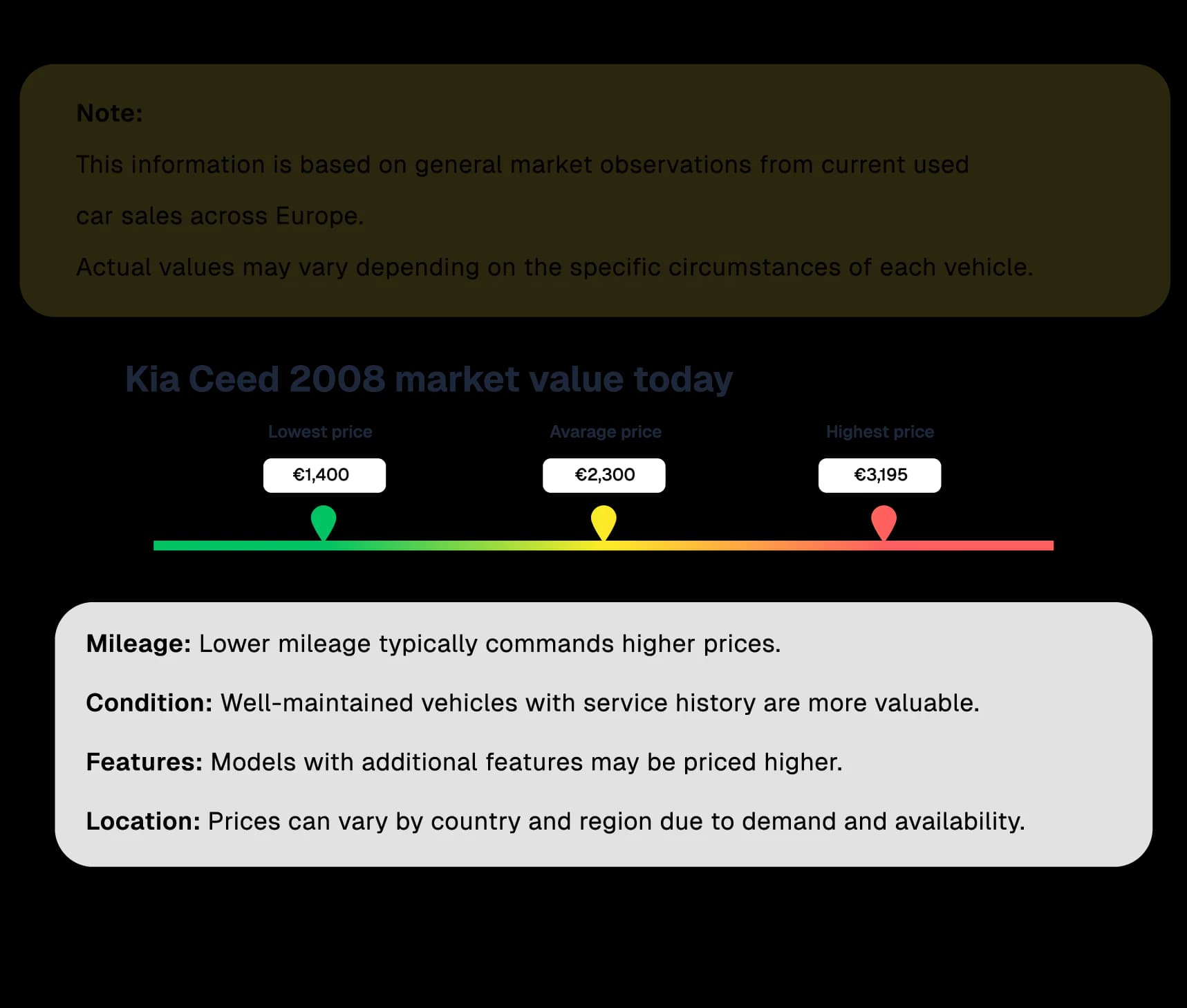
Market value
We compare prices from many sources to show the car's fair market value. This helps you know if the price is good or too high, so you can make a smart deal.
Trusted in 47+ countries worldwide
Carlytics aggregates vehicle data from 47+ European countries, pulling from national registries like Finnish Traficom (5M vehicles), Dutch RDW, Czech ISTP, and Danish DMR. Combined with NHTSA and EU Safety Gate recalls, the database covers 900M+ vehicles.
Access data from national registries,
insurance databases, law enforcement and more.

How It Works
Carlytics checks any VIN in under 10 seconds by cross-referencing 900M+ records from 47+ European countries. Enter a 17-character VIN, and the system searches NHTSA, EU Safety Gate and national registries to build a complete vehicle history report for NZ$15.90.
Get comprehensive vehicle information in just a few simple steps. Our process is designed to be quick, easy, and informative.
Enter Vehicle Details
Enter your license plate or VIN number to start the check process.
Instant Processing
Our system quickly searches through billions of records to find your vehicle.
Comprehensive Report
Receive a detailed report with complete vehicle history and important alerts.
Make Informed Decisions
Use the insights to make confident decisions about your vehicle purchase or sale.
Why Run a VIN Check Before Buying a Used Car?
A 2018 European Parliament resolution puts tampered mileage at an estimated 30-50% of cross-border used-car sales. Carlytics catches odometer rollbacks, undisclosed accident damage, stolen-vehicle flags, and open safety recalls by scanning 900M+ records across 47+ countries -- all from a single 17-character VIN, starting free.
Don't risk thousands on a used car with hidden problems. A free VIN check takes seconds and can save you from costly surprises.
Detect Odometer Fraud
According to a 2018 European Parliament resolution, an estimated 5–12% of domestic and 30–50% of cross-border used-car sales involve tampered mileage. A VIN history check reveals odometer rollback and mileage discrepancies that sellers try to hide.
Uncover Hidden Accident Damage
Structural damage from past accidents may not be visible during a physical inspection. A vehicle history report shows collision records the seller may not disclose.
Verify Stolen Vehicle Status
Over 600,000 vehicles are stolen in the EU each year, many resold across borders. Our stolen car database check confirms the vehicle is legally clear before you buy.
Check Cross-Border Import History
Vehicles imported from abroad may have different specs, undisclosed damage, or missing service records. Trace the full registration and import history with a VIN check.
Ready to check your vehicle?
Enter the VIN number below to get a free instant report.
Sample Vehicle Report
Every Carlytics report covers 24 sections including decoded specs, mileage history, safety recalls, theft status, market value, and cross-border import records. The full report costs NZ$15.90 and is available instantly as an interactive page and downloadable PDF.
Here's an example of the comprehensive vehicle report you'll receive. Our reports provide detailed information to help you make informed decisions about any vehicle.
Toyota Corolla (2019)
Silver • 1.8L • Petrol • Automatic
Vehicle Information
Technical Inspection Status
Vehicle Summary
Why a New Zealand used car is a different problem to a European one
New Zealand runs one of the most import-dependent car fleets in the developed world. That single fact changes what you should check, what a VIN can tell you, and where the risk actually sits.
Most countries buy cars that were built for them. New Zealand largely does not. A very large share of the light vehicles on New Zealand roads were first sold new somewhere else (overwhelmingly Japan, and after that the United Kingdom, Australia and the United States) and arrived here second-hand, with their first life already behind them. The paperwork that describes that first life almost never travels with the car.
The practical consequence for a buyer in Auckland or Christchurch is that the history you can see locally starts on the day the car was complied and registered here. Everything before that (how far it was driven in Japan, whether it was in a collision, whether it sat in a flooded car park) sits in records held offshore, in another language, by organisations that never dealt with you. A New Zealand history check that only looks at New Zealand records is looking at the shorter half of the car's life.
Roughly four in ten New Zealand cars have a VIN New Zealand issued, not the factory
This is the single most important thing to understand before you pay for any VIN-based check on a New Zealand car, and almost nobody explains it. A 17-character VIN is normally stamped by the manufacturer, and characters four to nine describe the model, body, engine family and restraint system exactly as the factory built it. That is what a VIN decoder reads.
Japanese-market vehicles are not built to that standard. They carry a chassis number instead, something in the shape of ZRE172-1234567 or GF-BH5-098765: which is shorter, differently structured, and not a VIN at all. When such a car is complied for New Zealand roads it is given a New Zealand VIN, in the world-manufacturer range that international standards allocate to New Zealand. In the country's publicly published vehicle register, roughly four in ten passenger cars and vans carry one of those New Zealand-assigned VINs, and the great majority of them are used imports from Japan.
Those seventeen characters are a valid, unique New Zealand identifier. They are not a factory record. Nothing in positions four to nine was written by Toyota, Nissan, Mazda, Honda or Subaru, so no decoder on earth, ours included, can recover the original grade, engine variant or factory options from them. Any service that returns a confident, detailed factory specification for a 7A-prefixed VIN is guessing from the make and model text, not decoding.
What you should do instead is find the original identifier. On a Japanese import it is usually still there: on the firewall plate in the engine bay, on the plate at the base of the B-pillar, or printed on the de-registration certificate the importer holds. That chassis number is the key that unlocks the Japanese-side documentation, the auction sheet, the export certificate and the odometer reading recorded at export.
Odometer risk here is an import problem, not a local one
Odometer tampering in New Zealand is mostly not a New Zealand crime. It happens in the gap between the last reading recorded overseas and the first reading recorded here, because in that gap nobody with an official record is watching. A car that left its origin market at 180,000 km can be presented at a New Zealand yard at 98,000 km, and unless someone goes back to the export paperwork, the lower number is simply what everybody works from afterwards.
This is why the export documentation matters so much more here than it would in Europe, where a chain of periodic inspections keeps a running record. Ask for the de-registration or export certificate and the auction sheet, and compare the kilometres on them against the dash. If the seller cannot produce either document for an imported car, treat the odometer as unverified rather than as correct: that is the honest reading, and it is the reading a careful buyer takes.
The other reading worth having is the last inspection record on the car in New Zealand, which is checked at a fixed interval and gives you at least one dated local data point. A trajectory that runs flat, or backwards, between two inspections is the clearest signal available to a private buyer.
Kilometres, right-hand drive, and the standards a car had to meet
New Zealand reads odometers in kilometres, which sounds trivial until an American-market import is involved: a car built for the United States records miles, and 90,000 on its dash is 145,000 km, not 90,000 km. It is a small, recurring source of accidental over-payment on US imports, and it is worth confirming which unit a dash is displaying before you compare a price to anything.
Right-hand drive keeps Japanese and British cars usable here without conversion, which is why they dominate the import flow. Cars converted from left-hand drive are a different proposition entirely and should be inspected as a modified vehicle, not as a standard one. And because emission and safety standards differ between the market a car was built for and the market it ends up in, an import can be entirely legitimate here while carrying equipment that differs from the same nameplate sold new in New Zealand.
What our check can and cannot show for a New Zealand car
We would rather you buy with accurate expectations than be disappointed after paying NZ$15.90. Here is the honest split for a car being sold in New Zealand.
What the check can tell you
- A full factory decode when the car carries a manufacturer-issued VIN: make, model, year, engine, transmission, body style and plant of origin.
- Open safety recall campaigns recorded for that make, model and year, which do not stop applying because the car changed country.
- Known issues and owner-complaint patterns reported for the model, so you know what tends to fail and roughly when.
- A stolen-vehicle check against the public databases we can reach.
- Dated vehicle history records and market-value context, where available for the VIN.
- Accident and damage records where available for the VIN, for example salvage and write-off title records and auction damage classifications.
What it cannot tell you
- A factory specification for a New Zealand-assigned VIN. Those seventeen characters were issued here, not by the manufacturer, so there is no build descriptor inside them to read.
- Japanese auction sheets, auction grades or the inspector's condition map. Those sit with the auction houses and the exporter.
- A New Zealand odometer history. We hold no per-car mileage record for this market and will not invent a trend line to fill the gap.
- Local registration, ownership or money-owing records. Those are held by New Zealand agencies and are not part of what we decode.
- Flood or hail damage that was never recorded anywhere. No history check of any kind can surface damage that was quietly repaired and never reported.
If the free decode comes back thin for your VIN, that is the answer telling you something real about the car's paperwork, and it is the moment to go looking for the original chassis plate rather than to pay for a fuller report.
Checking an imported car in New Zealand, in order
Five steps, cheapest first. Each one can end the process before you spend anything on the next.
- 1
Read the VIN and note what kind it is
Look at the windscreen plate and the door jamb. If the VIN starts with 7A, it was assigned in New Zealand and will not decode to a factory build, go and find the original chassis plate in the engine bay before anything else. If it starts with J, W, V, S, K or a digit, it is a manufacturer VIN and a decode will tell you a great deal.
- 2
Run the free decode
It costs nothing and it settles the first question: does the car in front of you match the car the VIN describes? Make, model year, engine and body style are the four that catch a misdescribed listing fastest, and a mismatch on any of them is worth an explanation before you go further.
- 3
Ask for the import paperwork by name
The export or de-registration certificate and, for a Japanese car, the auction sheet. You are looking for the kilometres recorded at export and any accident-repair grade. A seller who has the car's history will have these; a seller who cannot find either has told you something useful.
- 4
Compare the odometer against every dated record you have
Export kilometres, the earliest New Zealand inspection, the most recent inspection, and today's dash. You are not looking for an exact match; you are looking for a line that only ever goes up, at a believable rate. Anything flat or falling is the signal.
- 5
Pay for the full report, then get the car inspected
The report covers recalls, known failure patterns, the theft check and market context for NZ$15.90. It does not replace a physical pre-purchase inspection, and on a car with an unverifiable overseas history the inspection is the higher-value of the two. Do both, in that order, and you will have spent very little to avoid a large mistake.
Where to go next
If the car you are looking at came from Japan, the guide to reading an auction sheet and grade is the most useful next page: it teaches you to read the document that actually holds the answers. If the odometer is what worries you, the New Zealand odometer guide sets out how a wound-back import is normally caught. And if you want the whole sequence in one place, the New Zealand car history checklist covers what to verify before you commit.
Frequently Asked Questions
How do I check a VIN before buying a used or imported car in New Zealand?
Can Carlytics check Japanese-import (JDM) cars?
Does Carlytics include accident and damage data?
Can it detect flood-damaged and repaired cars?
What does a VIN check tell you?
Is it safe to share my VIN number?
How much does a vehicle history report cost?
Which countries does Carlytics cover?
Before you pay, read these
Our rankings and head-to-head comparisons against the major European VIN check services.
Best VIN Check in Europe 2026
7 services ranked by price, free tier, coverage and accuracy.
carVertical Alternative
Dated price and feature comparison, with sources.
Cheapest Vehicle History Report
Compare vehicle history report prices, from NZ$15.90.
Carfax Alternatives for European Cars
Why Carfax doesn't work in Europe, and what to use instead.
Last updated