Here's what your full Carlytics report looks like
Decode your VIN now to get yours — 60-second free decode, full history report S$12.90.
Everything we check on your VIN
Cross-referenced across 47+ countries — see exactly what your full report covers before you pay.
Avoid hidden problems
- Stolen vehicle checkCross-referenced against European theft registries.
- Mileage rollback detectionInspection-record cross-checks expose tampering.
- Accident & damage recordsReported collision and repair history where available.
- Active safety recallsOpen manufacturer recalls affecting this VIN.
- VIN identity verificationConfirms the 17-char VIN matches the vehicle's specs.
- Cross-border / import historyWhere the vehicle was previously registered.
Verify the seller's claims
- Make, model, year, trimAuthoritative decode from the original VIN data.
- Engine, transmission, fuelCapacity, power output, drivetrain configuration.
- Body, drive, factory colorOriginal equipment as configured at the plant.
- Country of origin & plantWhere the vehicle was actually built.
- Inspection / MOT historyPeriodic-test results, pass/fail, advisory notes (where available).
- Equipment & optionsFactory equipment package and original trim level.
Make a smart purchase
- Real-time market valueCurrent price band based on actual European listings.
- Running cost projectionEstimated annual fuel, insurance, maintenance.
- Tax & low-emission zonesGerman KFZ-Steuer + EU environmental-zone compatibility.
- Common problems & reliabilityKnown issues for this exact make and model.
- Maintenance scheduleRecommended service intervals and upcoming work.
- Battery health (EVs)Estimated state-of-health for electric vehicles.
- Charging cost & network (EVs)Per-kWh charging cost and station availability.
What you get for S$12.90
Measured on the reports we have actually sold — not on a marketing promise.
We query them whether or not they answer, and the report says which came back empty.
No waiting on a human, no follow-up email, no account to create.
Download the PDF whenever you like — the saved copy is yours to keep.
No subscription, no recurring charge, no account required.
Most used cars are fine. What you are buying is the confirmation, in writing, before you hand over the money.
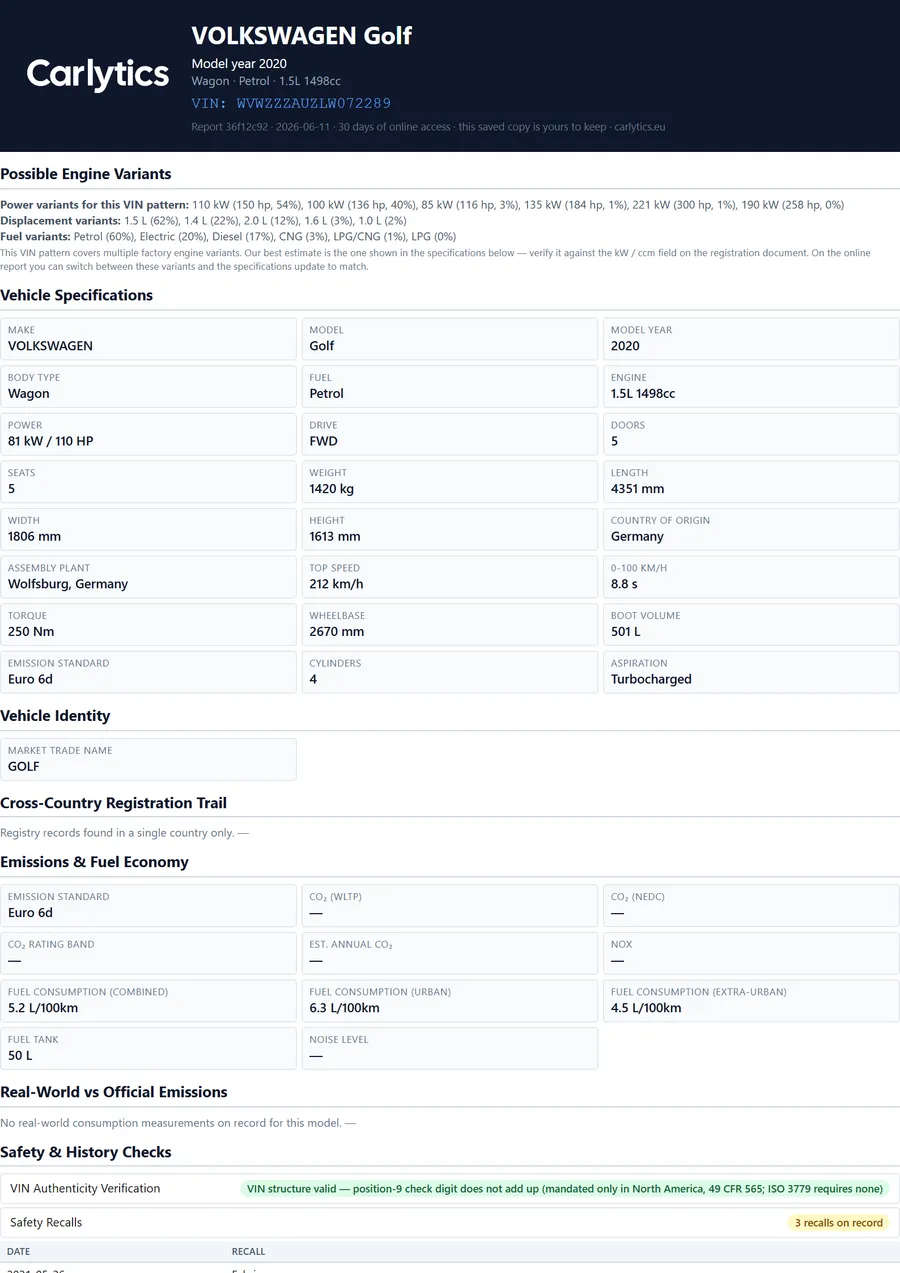
The PDF you download
Download the PDF whenever you like — the saved copy is yours to keep.
How to read the report below
Four things buyers miss on the first read.
- A dash is a finding, not an error
It means we hold no record for that field. A missing value is always shown as missing, never rounded up into a confident guess.
- “Nothing found” is the answer you paid for
A theft or damage check that comes back empty is a result: we looked in everything we hold, and this VIN is not in it.
- Recalls are matched on the model, not the car
Open recalls are found by make, model and year. Check each remedy against the service book — the work may already have been done.
- One VIN pattern can cover several engines
Where that happens the report lists the variants and their share. Compare the kW and ccm against the registration document.
Check your own VIN now
Enter any 17-character VIN to get a free vehicle decode. Upgrade to the full history report for S$12.90.
How we know the year and the mileage
A car can have three different years, and we keep them apart:
- Model year:
- the manufacturer's designation for the model version, taken from a record for your exact VIN where one exists, otherwise decoded from the VIN by that manufacturer's rules.
- Production year:
- when your individual car was built, from the manufacturer's production records.
- First registration year:
- when the car was first registered for the road, from official vehicle registers.
We show every year we can establish, even when two match. A record for your exact VIN takes precedence over an estimate from the VIN's structure. If a year cannot be established reliably, we leave it blank or show the model's production period rather than guess.
Mileage
Odometer readings come from official inspection records and market records, plotted by the date each was taken. Only official inspection readings are used to check whether the mileage ever went backwards, and the car's yearly mileage is compared with what is typical. We add new records every day.
How this sample would look for a Singapore car
The sample above is a European car with a complete manufacturer VIN and a long registry trail. A car bought in Singapore fills in differently, and it is fairer to tell you how before you pay.
The specification, recall and known-issues sections behave the same way for any car carrying a manufacturer-issued VIN, wherever it is sold. A Japanese-built parallel import or a German-built distributor car will both decode to a full factory build, and their recall campaigns apply to the build regardless of who imported it. Those parts of the sample are a fair preview.
The mileage section is where a Singapore report differs most. The sample shows a dated series of readings because the car lived in a market that records one at every periodic inspection. We hold no per-car Singapore odometer series, so that section will show what was actually found and, where nothing was found, will say so plainly. An empty row is the honest output; a modelled trend line would not be.
Nothing in the sample is a log card and nothing in a paid report will be. Registration date, remaining entitlement, declared power and capacity and the official chassis and engine identifiers come from the log card, which the seller can produce and we cannot. Read our report as the layer that describes the car; read the log card as the layer that describes the registration.
Market value is drawn from advertised stock, and a Singapore price is dominated by the entitlement position rather than by the car. Treat any value range as context about the vehicle rather than as a valuation of the purchase in front of you, and do the entitlement arithmetic separately — it is the bigger number. A ten-year-old hatchback and a ten-year-old executive saloon can converge on a similar asking price here for reasons that have nothing to do with either car, which is a pattern that would look inexplicable in any other market.
The recall section behaves in a way worth understanding before you read it. A campaign is issued against a build, usually by market, and it stays open against that build until the work is done on the individual car. For a parallel import, the campaign that matters is the one issued in the market the car was built for, not the one the local distributor ran — and the two are not always the same list. If an open campaign shows against your VIN, the practical next step is to ask an authorised workshop whether that specific chassis has already had the work carried out, because a completed repair abroad will not necessarily appear in anything you or we can see.
Two sections in the sample will look thinner on almost any Singapore car, and we would rather you knew which before paying. Import and registration records are one: we hold no local registration data, so the entry there reflects what could be established from the VIN and its public trail, not a registration file. Accident and damage records are the other: local claims sit with insurers, and no report priced anywhere near this one reaches them. An independent workshop inspection remains the only reliable way to establish whether a car has been repaired after a collision.
Everything in the sample is unlocked, so you can judge the depth before spending S$12.90. Run the free decode on the VIN you are actually considering first: on a parallel import it will tell you within seconds which market's car you are really buying.