Odometer rollback in Czech inspection records: what 83,000 cars show
A persistent drop of 5,000 km or more between two Czech inspections appears in 0.6–1.7% of cars (strict 0.56% [0.51–0.61]; primary 1.66% [1.57–1.75]).
- Last updated
- Reading time
- 1 min
- Methodology
- v1.0
The Czech Ministry of Transport publishes technical-inspection (STK) records, including odometer readings, as open data. Carlytics analysed 83,234 passenger cars inspected on eight random days in 2024–2025, with readings from 2008–2019 and 2024–2026.
Full study (Czech): Stočené kilometry v záznamech STK
1. Odometer drops are rare. A persistent drop of 5,000 km or more between two Czech inspections appears in 0.6–1.7% of cars (strict 0.56% [0.51–0.61]; primary 1.66% [1.57–1.75]).
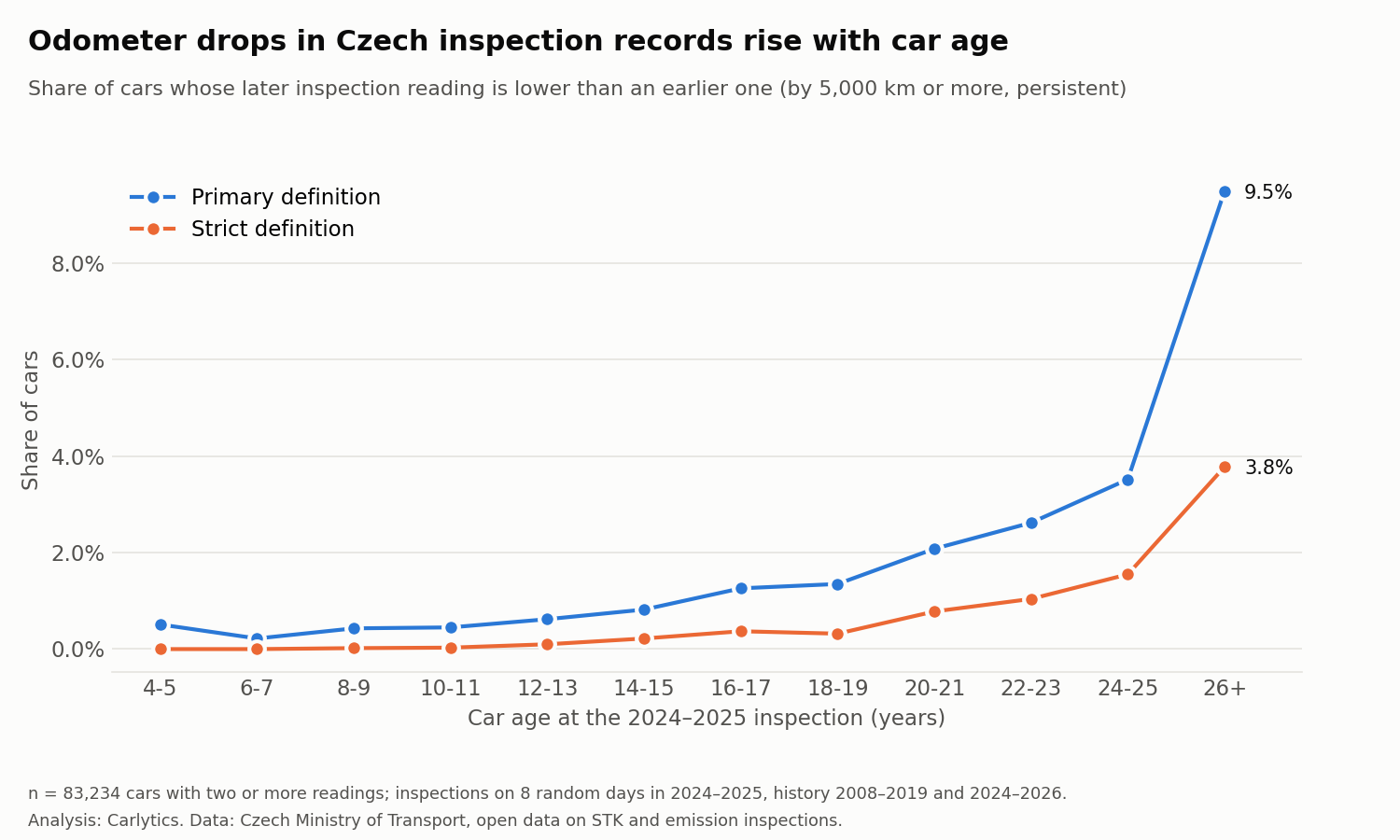
2. Age matters most.
- Under 10 years: 0.01–0.38%.
- 20 years and older: 1.57–3.92%.
- Median recorded drop: about 98,000 km.
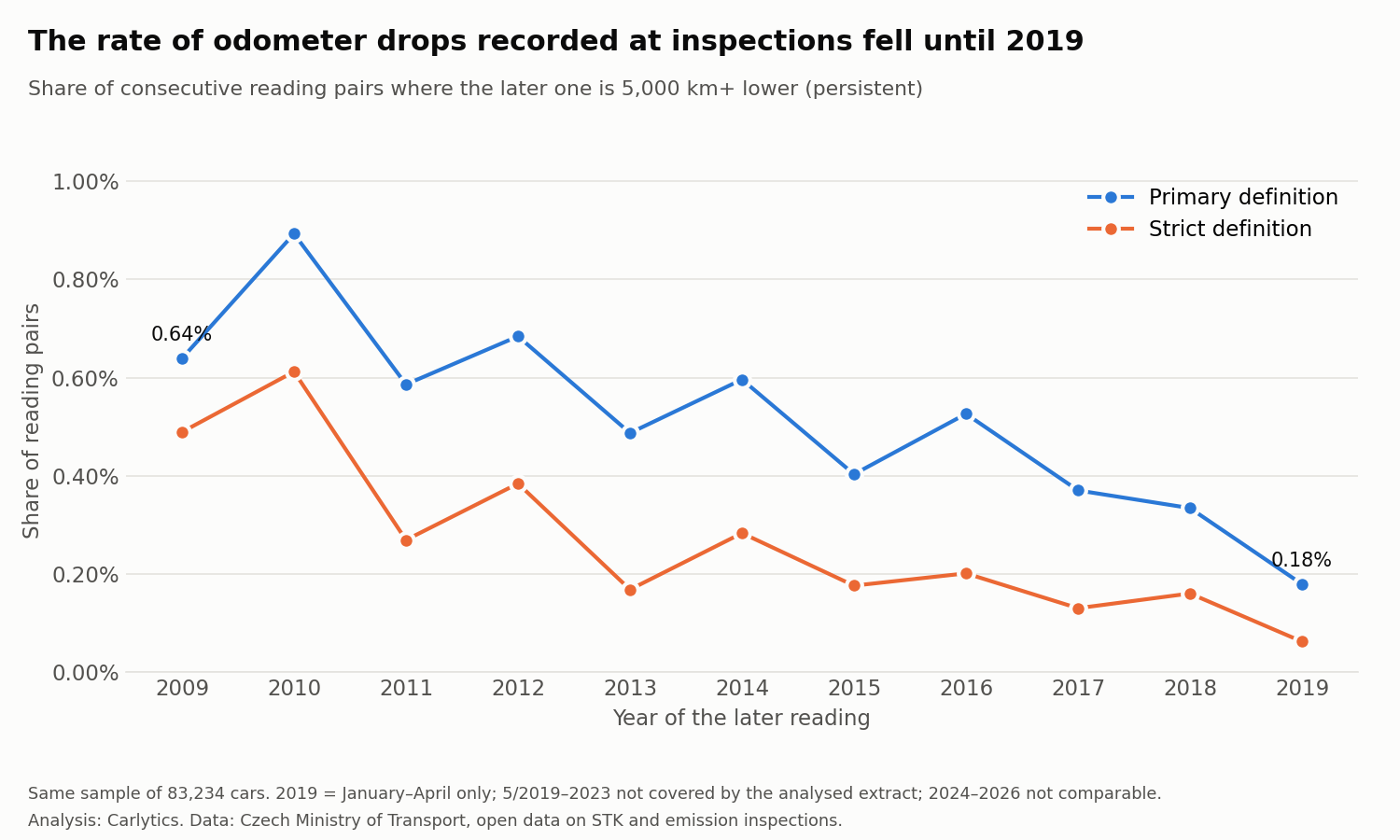
3. The rate fell over time. The share of inspections with a drop fell about 37% from 2010–2013 to 2016–2019.
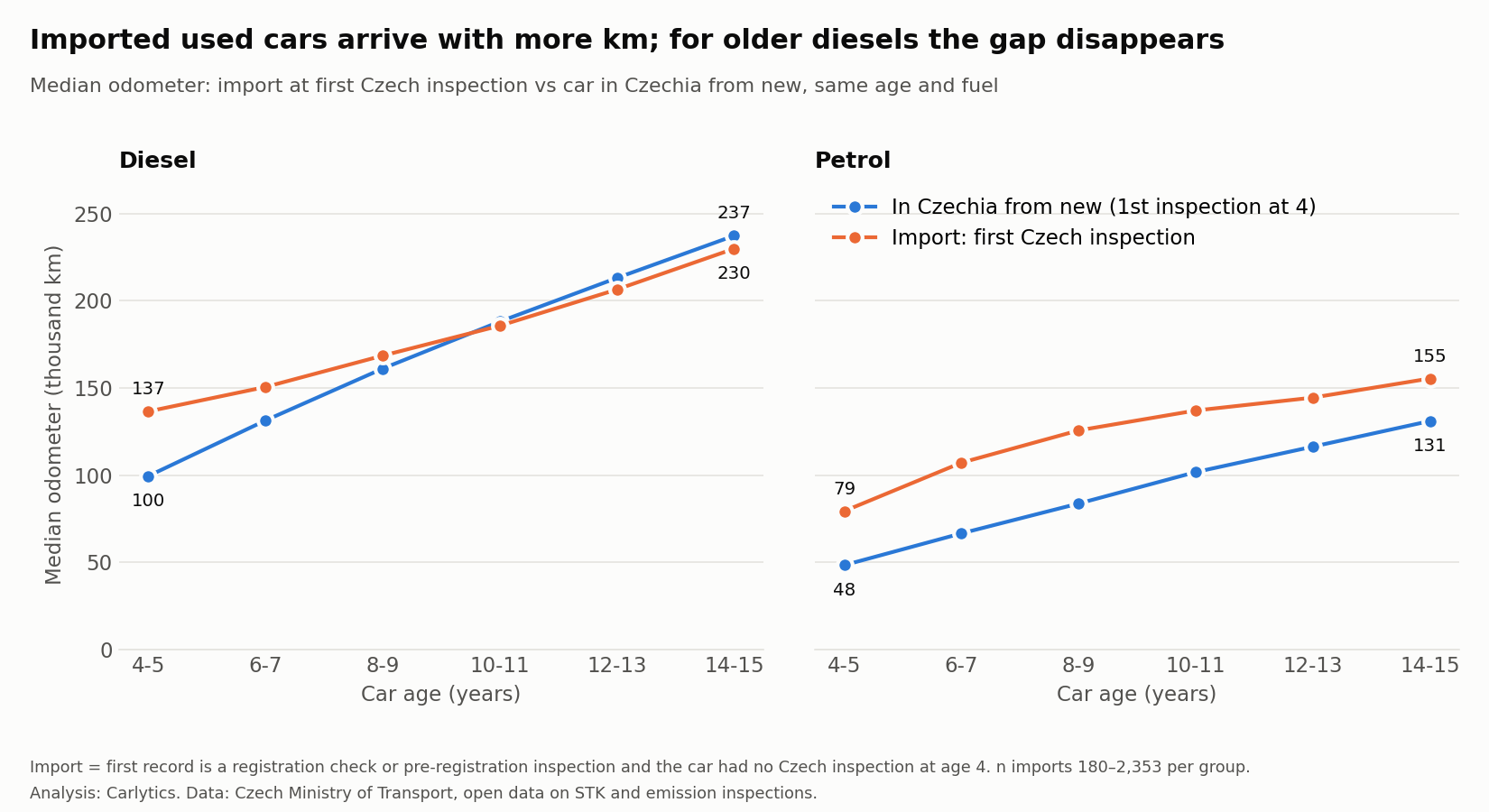
4. Imports arrive with more kilometres.
- At 4–5 years, the median import read 116,000 km at its first Czech inspection, against 61,000 km for a Czech-from-new car.
- For diesels older than about ten years the gap disappears.
- Both pre-registered import hypotheses (lower arrival mileage, faster driving after arrival) were falsified.
5. Adverts. Of cars advertised in September 2026 with a Czech inspection history (n = 5,781), 0.67% (about 1 in 150) state at least 5,000 km less than an earlier inspection reading.
Limits:
- Most of 2019–2023 is not covered.
- Rollback cannot be told apart from legal odometer replacement.
- Nothing before a car's first Czech inspection is visible.
Data: Czech Ministry of Transport open data "Prohlídky vozidel STK a SME" (Czech National Open Data Catalogue).