Odometer readings at the border: how often a used car gets "younger" after changing country
92% of 1,021 cross-border cars kept their reading within ±1,000 km.
- Last updated
- Reading time
- 1 min
- Methodology
- v1.0
We matched the same car (same 17-character VIN) across two consecutive public adverts in two countries, one of them Germany. The sample is young (median age 1 year), dealer-heavy and about 60% BMW.
Full study (German): Kilometerstand an der Grenze
What holds.
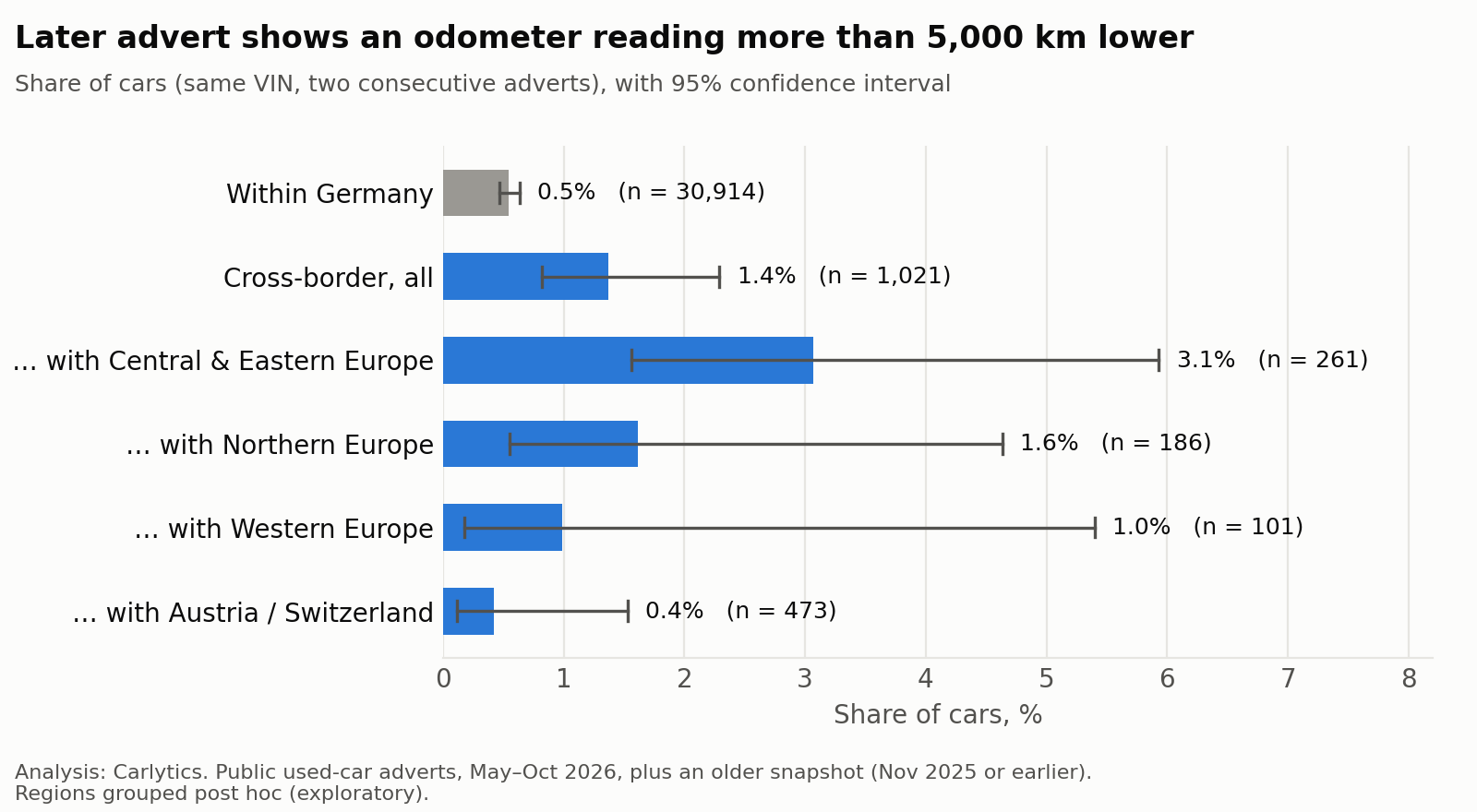
- 92% of 1,021 cross-border cars kept their reading within ±1,000 km.
- Germany ↔ Central/Eastern Europe: 3.1% (8 of 261, CI 1.6–5.9%) showed a later reading more than 5,000 km lower, vs 0.5% for cars re-advertised within Germany (168 of 30,914). Exploratory (regions grouped after data collection) and based on 8 cases, but it survives every robustness check.
- Germany ↔ Austria/Switzerland: 0.4%, the domestic level.
What is fragile.
- Pre-registered test, all cross-border cars: 1.4% vs 0.5%, risk ratio 2.5 (CI 1.5–4.3), p = 0.002.
- Dropping the few cars whose earlier advert came from an older November 2025 snapshot: RR 1.5 (CI 0.7–3.0), not significant.
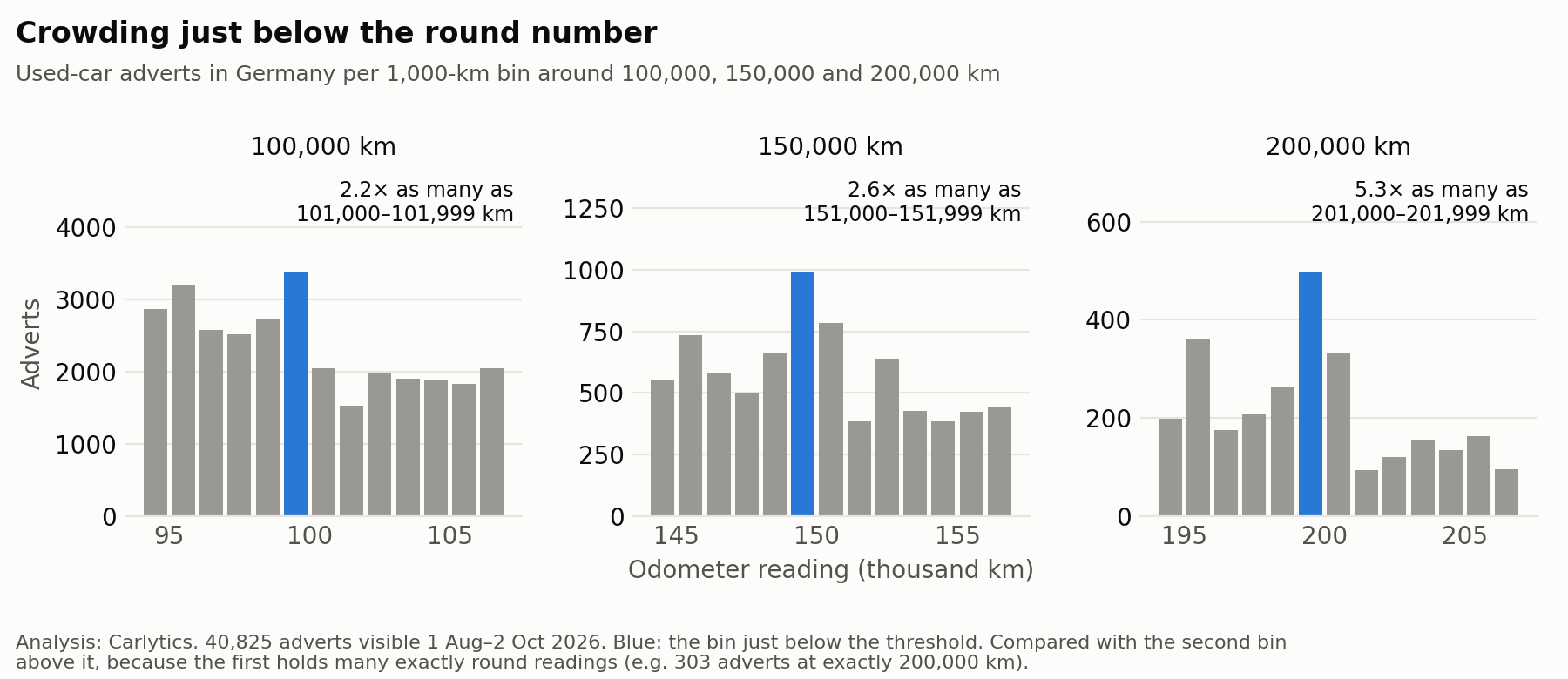
Second finding (pre-registered, robust). German adverts crowd just below round thresholds: 199,000–199,999 km vs 201,000–201,999 km, 5.3 times as many adverts (497 vs 93). At 150,000 km: 2.6 times. At 100,000 km: 2.2 times.
Limits. Adverts are seller statements, not measurements. A lower reading does not prove tampering. Subgroups are small.
How to cite: Carlytics Research (2026), Odometer readings at the border, carlytics.eu.